Conferences

Join Us for “Building a Feminist Future” at HASTAC 2017

HASTAC 2017: The Possible Worlds of Digital Humanities is right around the corner and I am so excited to be chairing the panel, “Building a Feminist Future: On (Digital) Pedagogical Praxis” (Friday, November 3, 1:45 PM – 3:15 PM in CB1-105; Session Number: FSA01).

Organized and facilitated by Emily EstenMelissa MeadeDanica SavonickWhitney Sperrazza, and Heather Suzanne Woods this session will be interactive–not your regular conference panel–and depend heavily on audience engagement. We will work together to explore what a feminist classroom looks and feels like and discuss strategies that you can integrate into your everyday teaching practices. The goal is to crowd-source a range of methods and resources that will be made available to all educators committed to feminist and antiracist pedagogy. Needless to say, this panel speaks to the Futures Initiative and HASTAC‘s emphasis on higher education as a public good.

Continue reading “Join Us for “Building a Feminist Future” at HASTAC 2017″
Events

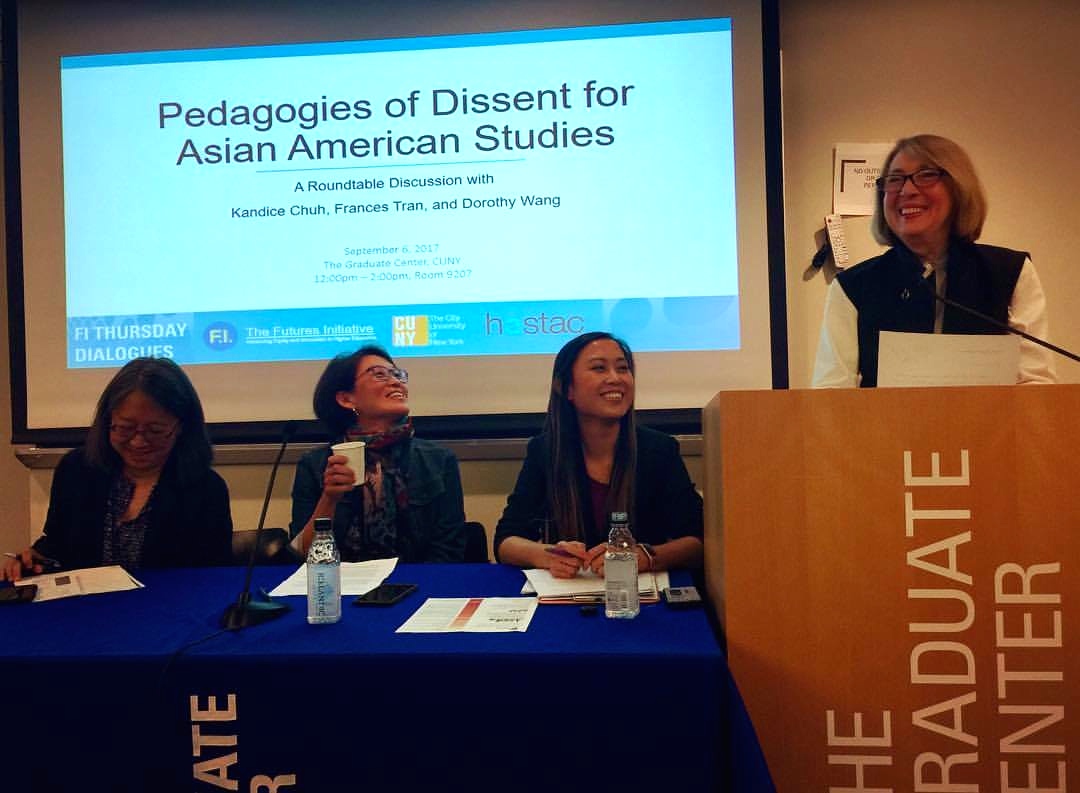
Event Announcement: Pedagogies of Dissent for Asian American Studies

I’m organizing the first of the Futures Initiative‘s new Thursday Dialogues series, a roundtable discussion on “Pedagogies of Dissent for Asian American Studies,” which takes inspiration from the theme of this year’s American Studies Association conference, “Pedagogies of Dissent” (November 9-12; Chicago, IL).

I am so excited to be in conversation with Kandice Chuh (Professor of English and American Studies, The Graduate Center, CUNY; President, American Studies Association) and Dorothy Wang (Associate Professor of American Studies and Faculty Affiliate in English, Williams College). See the flyer below for the full event description and hope to see you there!

Continue reading “Event Announcement: Pedagogies of Dissent for Asian American Studies”

Research

Reflections: From Dissertation to Book

It might be a bit early for me to write this post since I’m still working through my second chapter, but after Ken Wissoker, the Editorial Director of Duke University Press, visited our workshop last Tuesday, I wanted to share and reflect on his helpful insights and suggestions for thinking about the life my project will take on after the dissertation.

The differences between a dissertation and a book project:

One of the main distinctions is a question of audience. Whereas you often write your dissertation for a specific committee of scholars, your book project engages an entire field or set of discourses. You have to learn how to engage a broader critical audience who might not necessarily be as invested in your project in the same ways that your committee members are (for instance, in reading through every single chapter to the end).

Originality is key. While your project doesn’t have to be entirely new, there should be a clear sense of the unique contribution you are making to a field (or, better yet, fields).

Your presentation of objects and evidence will have a different rhythm and weight. In other words, book readers might not necessarily be as patient as your dissertation readers. While a chapter in your dissertation can be devoted to a long, extended analysis of one or two literary texts, in a book this might turn into a few paragraphs. In sum: the book only presents enough evidence and analysis necessary to make your argument.

Your voice matters above all others in the book. While the dissertation is often a place for you to rehearse your knowledge of key critical and theoretical discourses, the book should announce your authority on a subject matter. For that reason, many citations from secondary sources will become footnotes in the book to make room for your own voice and arguments to shine!

Continue reading “Reflections: From Dissertation to Book”

Events

Reflections on the ARC Conference

Last Friday I had the pleasure of presenting at the Archival Research Conference, sponsored by the Advanced Research Collaborative at The Graduate Center, CUNY. It was a wonderful opportunity to share my experiences working in the archives at Duke University, which I have discussed here and here. I was on the panel, “Mining Alternative Geographies of Race and Labor,” chaired by Professor Herman Bennett from the History program.

My paper, “Traces of the Coolie: An Archival Encounter” was largely a reflective piece, showcasing some of the important letters and documents I was able to find in the “Ballard’s Valley and Berry Hill Penn Plantation Records, 1766-1873” that contained references to coolies and coolie labor. Presenting alongside supportive colleagues and to such a generous audience gave me the confidence to share my questions and concerns about the materials I came across in this collection and how I plan to incorporate them into my dissertation. Usually introducing work that is still “in progress” would be a daunting experience  for me, but I found it energizing to participate in a conversation about how we approach archival research, including how to negotiate the volume of the material we collect and how to grapple with what is missing or absent from the archive.

Continue reading “Reflections on the ARC Conference”